
Next BBDG Seminar - The expanding universe of protein O-mannosylation: Structure, function, and human disease
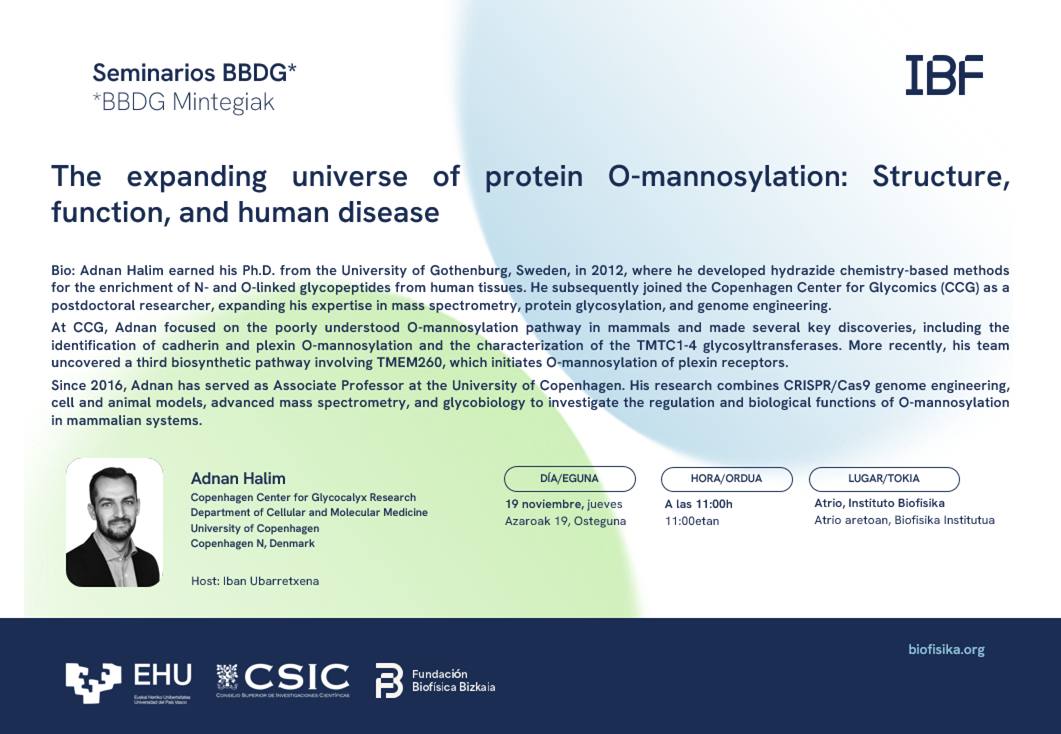
- • Adnan Halim (Copenhagen Center for Glycocalyx Research, Department of Cellular and Molecular Medicine, University of Copenhagen, Copenhagen N, Denmark)
- • Nov, Thu 19, 2026, 11:00
- • Félix M. Goñi Atrium (Instituto Biofisika)
- • "The expanding universe of protein O-mannosylation: Structure, function, and human disease"
Bio: Adnan Halim earned his Ph.D. from the University of Gothenburg, Sweden, in 2012, where he developed hydrazide chemistry-based methods for the enrichment of N- and O-linked glycopeptides from human tissues. He subsequently joined the Copenhagen Center for Glycomics (CCG) as a postdoctoral researcher, expanding his expertise in mass spectrometry, protein glycosylation, and genome engineering.
At CCG, Adnan focused on the poorly understood O-mannosylation pathway in mammals and made several key discoveries, including the identification of cadherin and plexin O-mannosylation and the characterization of the TMTC1-4 glycosyltransferases. More recently, his team uncovered a third biosynthetic pathway involving TMEM260, which initiates O-mannosylation of plexin receptors.
Since 2016, Adnan has served as Associate Professor at the University of Copenhagen. His research combines CRISPR/Cas genome engineering, cell and animal models, advanced mass spectrometry, and glycobiology to investigate the regulation and biological functions of O-mannosylation in mammalian systems.